
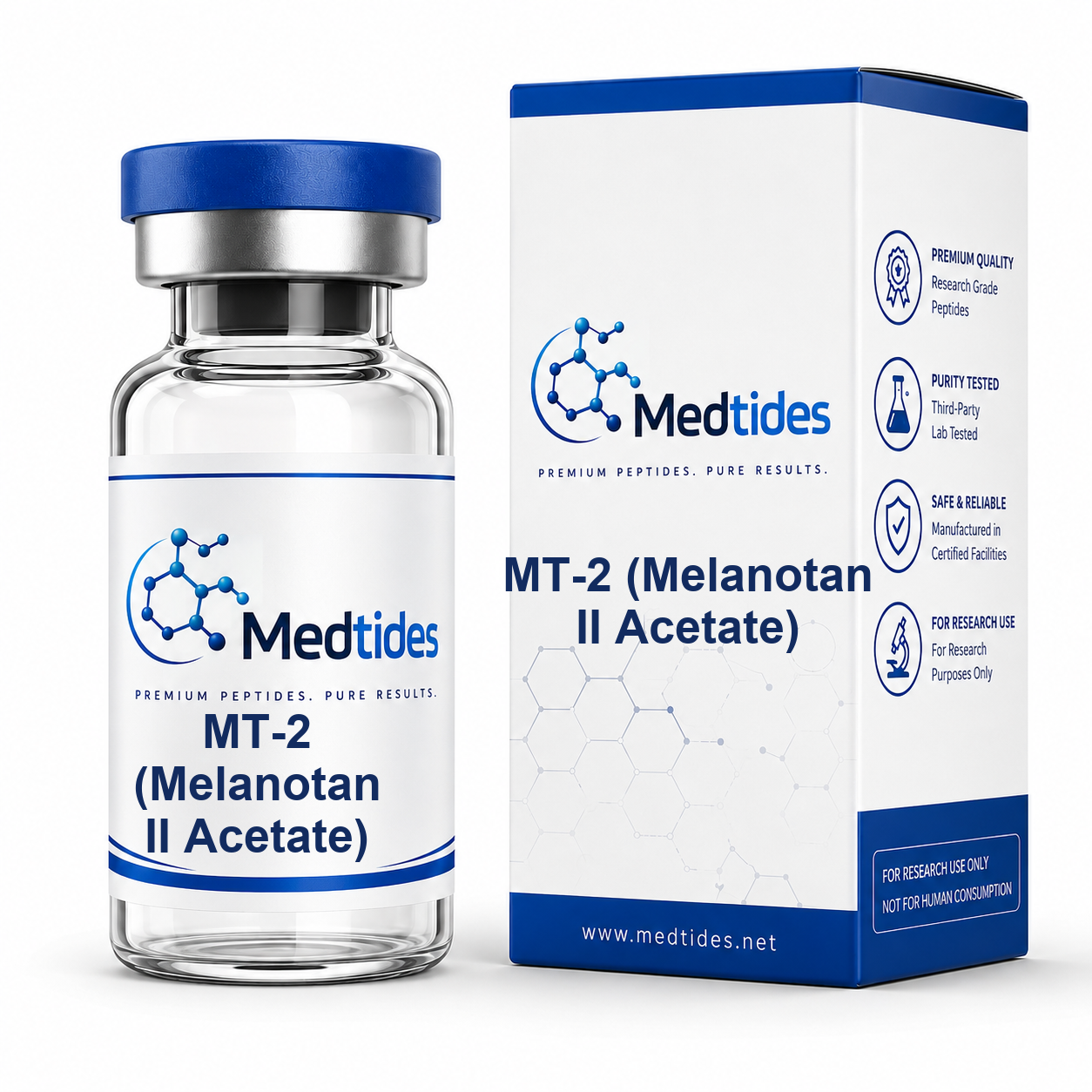
Buy MT-2 (Melanotan II Acetate)
Original price was: $50.00.$40.00Current price is: $40.00.
MT-2 (Melanotan II Acetate)
1. Overview
MT-2 (Melanotan II Acetate) is a synthetic peptide analogue of alpha-melanocyte-stimulating hormones(α-MSH). It belongs to a group of compounds known as melanocortin receptor agonists, which interact with melanocortin receptors involved in pigmentation and several other physiological processes. MT-2 was originally investigated for its ability to stimulate the production of melanin, the pigment responsible for skin coloration.
Because of its biological activity, MT-2 (Melanotan II Acetate) has attracted interest in research involving skin pigmentation, photobiology, melanocortin signaling, appetite regulation, and sexual function. However, it remains an investigational compound and should not be confused with approved medicines containing related melanocortin agonists.
2. Mechanism of Action
MT-2 (Melanotan II Acetate) acts by binding to melanocortin receptors, particularly MC1R, which is found on melanocytes. Activation of MC1R stimulates melanocytes to increase the production of melanin, particularly eumelanin, which can produce darker pigmentation.
MT-2 (Melanotan II Acetate) can also interact with other melanocortin receptors, including MC3R and MC4R. These receptors participate in biological pathways associated with energy balance, appetite, sexual behavior, and other physiological functions. Consequently, the effects of MT-2 may extend beyond pigmentation.
3. Research Applications
MT-2 (Melanotan II Acetate) has been investigated in several areas of biomedical research. One major area is pigmentation research, where scientists study how melanocortin receptors regulate melanin production and skin pigmentation.
Another area is photobiology. Increased melanin can absorb some ultraviolet radiation, so researchers have investigated melanocortin signaling as a possible mechanism for increasing the skin’s natural photoprotective response. Importantly, increased pigmentation should not be considered a substitute for sunscreen or other established methods of UV protection.
MT-2 (Melanotan II Acetate) has also been investigated for its effects on sexual function. Activation of melanocortin pathways, particularly MC4R-related pathways, has been associated with sexual arousal and erectile responses in experimental studies. Researchers have additionally examined melanocortin signaling in relation to appetite and energy regulation.
4. Potential Uses
Because MT-2 is not an approved therapeutic product, its potential uses should be described primarily in terms of research rather than established medical treatment. Areas investigated include:
- Stimulation of melanin production and pigmentation.
- Study of melanocortin receptor activity.
- Investigation of mechanisms involved in sexual arousal and sexual function.
- Research into appetite and energy regulation.
- Investigation of skin responses to ultraviolet radiation.
- Development of knowledge concerning melanocortin-based therapies.
5. Administration and Research Use
MT-2 has commonly been investigated as a peptide administered by injection in experimental settings. However, there is no universally approved dosing schedule or self-administration protocol for MT-2 because it has not been approved as a general medical or cosmetic treatment. Products sold online may also vary substantially in purity, concentration, sterility, and composition.
For these reasons, research-grade MT-2 should be handled only according to appropriate laboratory procedures and institutional requirements. It is not appropriate to assume that instructions provided by online vendors constitute medically validated administration guidance.
6. Safety and Limitations
Reported effects associated with MT-2 include nausea, facial flushing, headache, fatigue, increased pigmentation, and changes in existing moles or freckles. Other melanocortin-related effects, including spontaneous erections, have also been reported. The long-term safety profile of MT-2 has not been adequately established.
A particularly important concern is that changes in pigmented lesions may make it more difficult to identify potentially significant skin changes. Individuals noticing changes in a mole, freckle, or other pigmented lesion should seek evaluation from a qualified healthcare professional.
7. Regulatory Status and Conclusion
MT-2 (Melanotan II Acetate) remains an investigational peptide and is not approved by major regulatory authorities such as the FDA for cosmetic tanning or general therapeutic use. Although research has demonstrated significant biological activity, further controlled studies are necessary to establish its safety, effectiveness, pharmacology, and long-term effects in humans.
Overall, MT-2 is primarily valuable as a research compound for studying melanocortin biology, pigmentation, and related physiological pathways. Its experimental status and uncertain long-term safety mean that it should not be regarded as an established medication or routine cosmetic treatment.
MT-2, also known as Melanotan II Acetate, is a synthetic cyclic peptide belonging to the melanocortin peptide family. It is widely studied in laboratory research for its interaction with melanocortin receptors and its role in peptide-mediated cellular signaling pathways.
Be the first to review “Buy MT-2 (Melanotan II Acetate)”
Related products
PEPTIDES PRODUCTS
PEPTIDES PRODUCTS
PEPTIDES PRODUCTS
PEPTIDES PRODUCTS
PEPTIDES PRODUCTS
PEPTIDES PRODUCTS
PEPTIDES PRODUCTS
PEPTIDES PRODUCTS
Reviews
There are no reviews yet.