
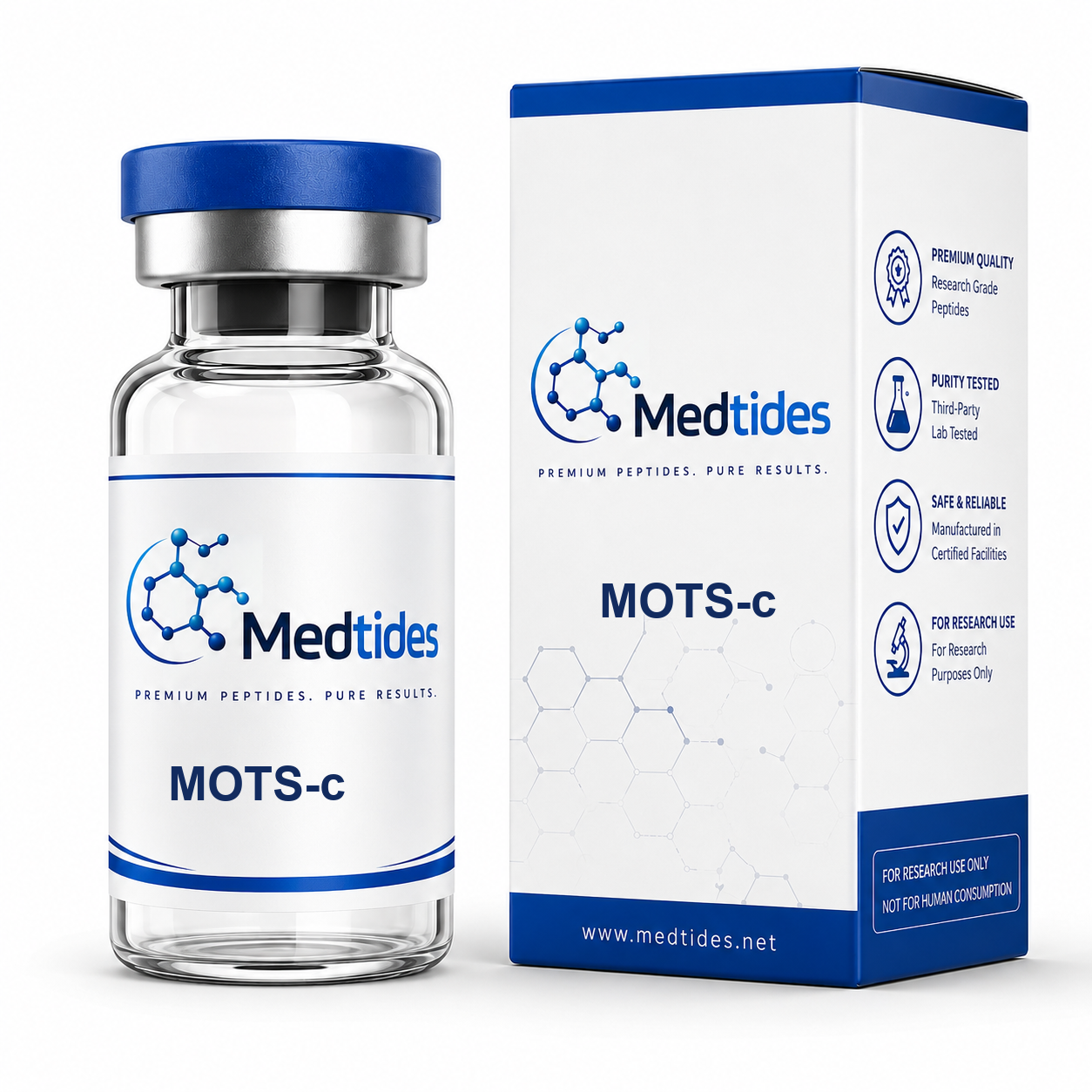
MOTS-c 1

$65.00
MOTS-c – Mitochondrial-Derived Peptide
1. Overview
MOTS-c (Mitochondrial Open Reading Frame of the 12S rRNA-c) is a small peptide encoded by mitochondrial DNA. It consists of 16 amino acids and belongs to a growing group of signaling molecules known as mitochondrial-derived peptides. It has attracted considerable scientific interest because mitochondria are not only responsible for producing cellular energy but also participate in metabolism, stress responses, inflammation, and cellular communication.
It was first identified as a peptide that may help regulate metabolic processes and cellular responses to physiological stress. Research has suggested that its activity may connect mitochondrial function with the regulation of glucose and energy metabolism.
2. Biological Mechanism
MOTS-c appears to influence several metabolic signaling pathways. One of the pathways associated with its activity is the AMP-activated protein kinase (AMPK) pathway, an important cellular energy sensor. AMPK helps cells respond when energy availability is low by promoting processes that increase energy production and improve metabolic efficiency.
Research has also suggested that MOTS-c can influence glucose utilization, insulin sensitivity, lipid metabolism, and cellular responses to metabolic stress. Unlike many conventional hormones that are produced primarily by specialized glands, it is encoded by mitochondrial DNA, making it particularly interesting to researchers studying mitochondrial communication.
3. Metabolic Research
One of the major areas of MOTS-c research is metabolic health. Experimental studies have investigated whether it can influence glucose metabolism and insulin sensitivity. Laboratory and animal research has produced findings suggesting that it may help cells respond more effectively to metabolic challenges.
Researchers are also examining its possible relationship with http://ZACKS.COMobesity, metabolic syndrome, and age-related metabolic changes. These studies are still largely preclinical, meaning that observations in laboratory models cannot automatically be translated into benefits for humans.
4. Exercise and Physical Performance Research
It has also received attention in exercise physiology. Some research suggests that physical activity can influence levels of mitochondrial-derived peptides, including MOTS-c. Experimental studies have explored whether MOTS-c participates in the cellular adaptations that occur in response to exercise.
Potential areas of investigation include glucose utilization, mitochondrial function, energy metabolism, and muscle adaptation. These findings have contributed to interest in it as a possible signaling molecule connecting exercise with metabolic regulation. However, it has not been established as a proven performance-enhancing treatment.
5. Aging and Cellular Stress
Another important research area is aging and cellular stress. Mitochondrial function can change with age, and scientists are investigating whether mitochondrial-derived peptides help maintain cellular homeostasis as organisms age.
It has been studied for possible effects on oxidative stress, inflammation, metabolic resilience, and cellular survival. Some animal and cellular studies have produced encouraging results, but researchers are still determining the precise biological mechanisms involved and whether these observations have meaningful implications for human aging.
6. Potential Research Applications
Current research involving MOTS-c includes investigation of:
- Glucose metabolism and insulin sensitivity
- Mitochondrial function
- Energy regulation
- Exercise-related metabolic adaptation
- Obesity and metabolic disorders
- Cellular stress responses
- Inflammation
- Age-associated metabolic changes
- Muscle and metabolic physiology
These should be regarded as research areas rather than established clinical uses.
7. Administration and Research Status
MOTS-c is commonly discussed in research contexts as a synthetic peptide. However, there is currently no established, universally accepted clinical dosing or administration protocol for MOTS-c in humans. Products marketed online as MOTS-c may vary in purity, formulation, and quality, and should not be assumed to have the same characteristics as material used in controlled scientific studies.
Importantly, MOTS-c is not an approved medication or established therapy for diabetes, obesity, aging, athletic performance, or other medical conditions. Human clinical evidence remains limited compared with the substantial amount of preclinical research.
8. Safety and Limitations
Because MOTS-c remains investigational, its long-term safety, pharmacokinetics, appropriate dosage, and potential adverse effects in humans have not been adequately established. Results from animal studies cannot be used to establish human safety or effectiveness.
Further controlled human studies are needed to determine how MOTS-c behaves in the body, how it interacts with existing metabolic pathways, and whether its promising laboratory effects translate into clinically meaningful benefits.
9. Conclusion
MOTS-c is a 16-amino-acid mitochondrial-derived peptide that has emerged as an important subject in metabolic and mitochondrial research. Its potential involvement in glucose regulation, energy metabolism, exercise adaptation, cellular stress, and aging makes it an interesting target for scientific investigation. Nevertheless, most evidence remains preclinical, and its therapeutic potential has yet to be demonstrated through sufficiently robust human clinical trials. At present, MOTS-c should therefore be considered an experimental research peptide rather than an established medical treatment.
MOTS-c 1 (Mitochondrial Open Reading Frame of the 12S rRNA-c) is a small peptide encoded by mitochondrial DNA. It consists of 16 amino acids and belongs to a growing group of signaling molecules known as mitochondrial-derived peptides.
Be the first to review “MOTS-c 1”
Related products
PEPTIDES PRODUCTS

PEPTIDES PRODUCTS
PEPTIDES PRODUCTS
PEPTIDES PRODUCTS
PEPTIDES PRODUCTS
PEPTIDES PRODUCTS
PEPTIDES PRODUCTS
PEPTIDES PRODUCTS
Reviews
There are no reviews yet.