
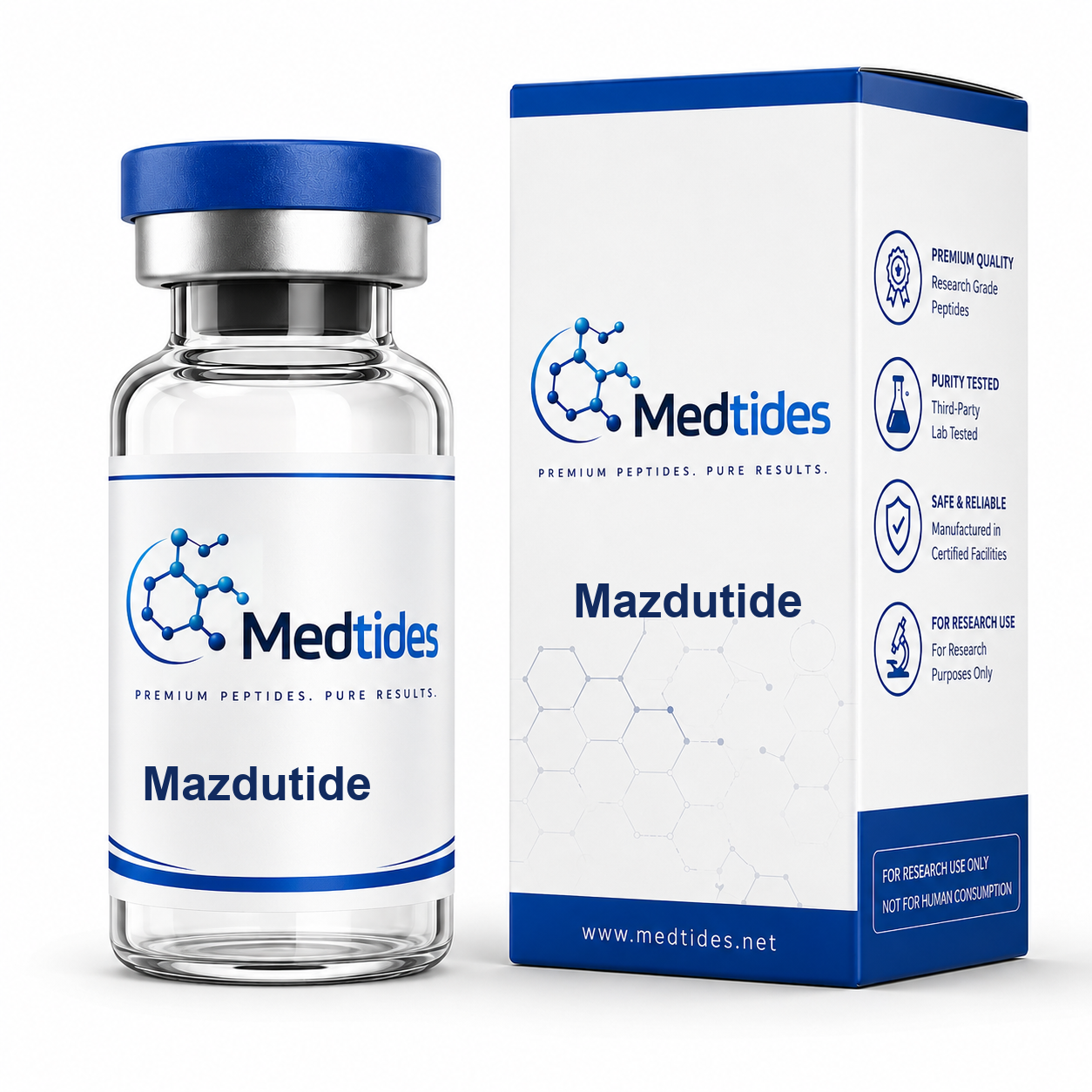
Mazdutide 1
Original price was: $150.00.$105.00Current price is: $105.00.
Mazdutide: Description, Usage, and Storage
Mazdutide is a long-acting peptide medicine that belongs to a newer class of metabolic therapies known as dual glucagon receptor (GCGR) and glucagon-like peptide-1 receptor (GLP-1R) agonists. Unlike medicines that act primarily through the GLP-1 pathway, mazdutide is designed to stimulate both GLP-1 and glucagon receptors. This dual action is intended to influence appetite, glucose metabolism, body weight, and energy utilization simultaneously. Mazdutide is also known by the development code IBI362 and has been developed by Innovent Biologics in collaboration with Eli Lilly.
The drug represents an important development in the treatment of obesity and metabolic disease. In June 2025, China’s National Medical Products Administration approved mazdutide for long-term weight management in adults with overweight or obesity, alongside diet and increased physical activity. It subsequently received approval in China for glycemic control in adults with type 2 diabetes. (Innovent Bio)
How Mazdutide Works
The best way to understand mazdutide is to imagine it as a biological messenger that communicates with two metabolic control systems at once.
The GLP-1 component helps regulate appetite and food intake. Activation of GLP-1 receptors can increase glucose-dependent insulin secretion, slow gastric emptying, and promote a feeling of fullness after eating. These effects can make it easier for some patients to consume fewer calories.
The glucagon component provides a complementary metabolic signal. Glucagon is involved in regulating energy availability and can promote the mobilization and utilization of stored energy. By activating both receptors, mazdutide is intended to combine appetite reduction with broader metabolic effects.
Clinical studies have produced substantial weight-loss results. In the GLORY-1 phase 3 trial, adults with overweight or obesity receiving once-weekly mazdutide experienced significantly greater weight reduction than those receiving placebo. At 48 weeks, mean weight changes were approximately −11.0% with 4 mg and −14.0% with 6 mg, compared with approximately 0.3% with placebo. Improvements were also observed in prespecified cardiometabolic measures. (PubMed)
More recent research has examined higher doses. In a 60-week phase 3 study, a 9 mg once-weekly regimen produced an average weight reduction of approximately 16.65% from baseline in Chinese adults with obesity. (PubMed) These results are encouraging, although higher doses can also bring greater tolerability considerations.
Usage of Mazdutide
Mazdutide is administered by subcutaneous injection, meaning that the medicine is delivered into the fatty tissue beneath the skin rather than taken as a conventional tablet. Clinical studies have generally evaluated once-weekly administration.
The medicine is intended to be used as part of a broader weight-management or metabolic-treatment program rather than as a replacement for healthy nutrition and physical activity. In the approved weight-management indication, mazdutide is used together with dietary control and increased physical activity. (PubMed)
One particularly important point is that the strength written on a vial or package does not necessarily represent the starting dose for a patient. Clinical trials commonly use gradual dose escalation. This allows the body to adapt to the medicine and can help reduce gastrointestinal adverse effects. The exact starting dose, escalation schedule, maintenance dose, injection technique, and treatment duration should therefore come from the approved prescribing information and a qualified healthcare professional.
Mazdutide should not be self-administered according to dosing schedules copied from internet forums, peptide vendors, bodybuilding communities, or research protocols. Clinical-trial doses are designed for controlled research conditions and do not automatically constitute instructions for individual treatment.
Expected Effects
The most noticeable effect for many patients is a reduction in appetite and food intake. As treatment progresses, reduced appetite combined with metabolic effects can contribute to progressive weight loss.
Research has also demonstrated effects on blood glucose control. In a phase 3 study involving adults with type 2 diabetes, once-weekly 4 mg and 6 mg mazdutide produced significant reductions in HbA1c compared with placebo. Weight reduction also occurred in the treatment groups. (PubMed)
These findings illustrate why mazdutide is being studied not simply as a weight-loss medicine, but as a broader metabolic therapy.
Common Side Effects
Mazdutide’s effects on the gastrointestinal system mean that digestive symptoms are among the most frequently reported adverse effects. These can include nausea, diarrhea, vomiting, constipation, abdominal discomfort, and reduced appetite. In clinical studies, gastrointestinal reactions were generally among the most common adverse events and were frequently mild to moderate. (PubMed)
Symptoms may be particularly noticeable during the period when the dose is being increased. Patients should tell their healthcare professional about persistent or severe symptoms, especially repeated vomiting, significant dehydration, or severe abdominal pain.
Because mazdutide affects glucose metabolism, individuals with diabetes or those taking other glucose-lowering medicines require appropriate medical monitoring. The treatment decision should take into account a person’s medical history, other medications, nutritional status, and individual risk factors.
Storage of Mazdutide
Storage is especially important for peptide medicines. A pharmaceutical peptide is not something that should simply be left on a desk, in a hot vehicle, or exposed to prolonged sunlight. Temperature, light, handling, and contamination can all influence pharmaceutical quality.
The most important rule is to follow the storage instructions printed on the official product packaging and prescribing information for the specific mazdutide formulation. The exact requirements can depend on the registered product, formulation, and packaging. Official Chinese drug-storage requirements state that medicines should be stored according to the temperature requirements indicated on their packaging, with appropriate protection from light, moisture, contamination, and other environmental factors. (National Medical Products Administration)
If the official product specifies refrigerated storage, it should be maintained within that specified temperature range using a reliable pharmaceutical refrigerator or appropriate temperature-controlled system. It should not be frozen unless the manufacturer’s instructions explicitly permit freezing. Accidental freezing can be particularly problematic for injectable biological or peptide products.
During transportation, maintaining the manufacturer’s specified temperature is equally important. Chinese pharmaceutical distribution standards specifically require appropriate temperature control for medicines that require refrigeration and warn against direct contact between refrigerated medicines and ice packs or other coolants. (National Medical Products Administration)
The product should also remain in its original labeled packaging whenever practical. This helps protect it from light and, equally importantly, preserves the identity, batch number, expiry date, and storage instructions. The packaging should be inspected for damage, leakage, broken seals, or other abnormalities before use.
If a product has been exposed to unusually high temperatures, frozen accidentally, left unrefrigerated for an uncertain period, or otherwise stored outside its labeled conditions, it should not automatically be assumed to remain suitable for injection. The safest approach is to contact the dispensing pharmacy or manufacturer for product-specific stability guidance rather than guessing.
Handling and Quality
A legitimate pharmaceutical product should be handled as a sterile injectable medicine. The injection device and medication should not be shared between people. Clean administration practices are essential because contamination can introduce microorganisms and create serious health risks.
This is particularly important when comparing approved pharmaceutical mazdutide with products sold online as “research peptides.” An internet product may not have the same manufacturing controls, sterility assurance, concentration accuracy, stability testing, or regulatory oversight as an approved medicine. Consequently, a vial labeled “Mazdutide 10 mg,” for example, should not automatically be assumed to have the same quality or formulation as an approved pharmaceutical presentation.
Overall Perspective
Mazdutide is an intriguing advancement in metabolic medicine because it combines two biological signals—GLP-1 receptor activation and glucagon receptor activation—within one long-acting molecule. Its clinical development has demonstrated meaningful effects on body weight and glucose regulation, while ongoing research continues to examine its potential applications in other metabolic conditions. (PubMed)
Its vivid appeal lies in the way it approaches metabolism from two directions: reducing appetite and food intake while simultaneously influencing the body’s energy and glucose pathways. Yet its potency is precisely why responsible use matters. Mazdutide is not simply a conventional supplement; it is a pharmacologically active prescription medicine requiring appropriate dosing, monitoring, and storage.
For storage, the central principle is equally straightforward: protect the medicine from inappropriate temperature, light, moisture, contamination, and accidental freezing, and always follow the specific manufacturer’s label rather than relying on a generic peptide-storage rule. Official pharmaceutical guidance emphasizes that storage conditions should match the approved requirements for the particular product. (National Medical Products Administration)
Ultimately, mazdutide should be viewed as a clinically significant metabolic therapy—not merely as a weight-loss product. Its benefits need to be balanced against potential adverse effects, individual medical circumstances, and the importance of obtaining the medicine from a legitimate, regulated pharmaceutical source.
Mazdutide
Be the first to review “Mazdutide 1”
Related products
PEPTIDES PRODUCTS
PEPTIDES PRODUCTS
PEPTIDES PRODUCTS
PEPTIDES PRODUCTS
PEPTIDES PRODUCTS
PEPTIDES PRODUCTS
PEPTIDES PRODUCTS
PEPTIDES PRODUCTS
Reviews
There are no reviews yet.