
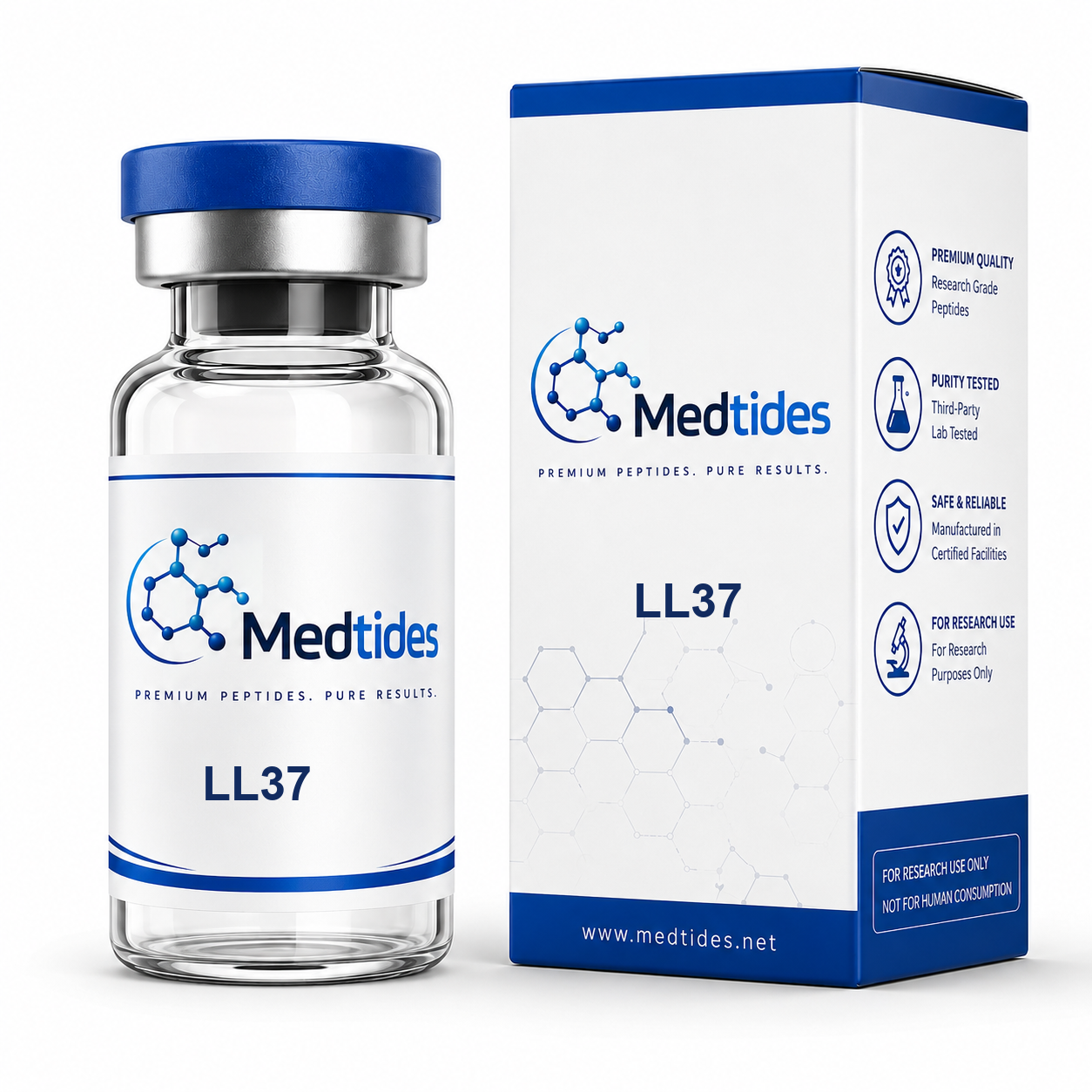
LL37
Original price was: $100.00.$90.00Current price is: $90.00.
LL37
LL37 is a naturally occurring human antimicrobial peptide that forms an important part of the body’s innate immune system. Unlike antibodies, which are produced as part of a more specialized immune response, LL-37 belongs to a group of molecules that provide rapid, first-line protection against invading microorganisms. It is the only known human member of the cathelicidin family and has attracted considerable scientific interest because its activities extend far beyond simply killing bacteria. Research has associated LL-37 with antimicrobial defense, immune regulation, inflammation, cell migration, angiogenesis, and tissue repair. (PubMed)
The name LL37 reflects the mature peptide’s structure: it contains 37 amino-acid residues and begins with two leucine residues. LL37 is derived from a larger precursor protein called human cationic antimicrobial protein 18 (hCAP18), which is encoded by the CAMP gene. hCAP18 is produced by several types of cells and is stored in particular immune-cell compartments. When the body encounters injury, inflammation, or microbial challenge, enzymes can process the precursor and release the biologically active LL-37 peptide. (PubMed)
Structure and Characteristics
LL37 is a cationic, amphipathic peptide, meaning that it carries a net positive charge and contains both water-compatible and lipid-interacting regions. This combination is extremely important to its biological behavior. Many microbial membranes contain negatively charged components, allowing LL37 to interact with them electrostatically. Once associated with a microbial membrane, LL37 can disturb membrane organization and, under appropriate conditions, create membrane defects or pores that compromise the microorganism.
Its structure is relatively small and flexible compared with many larger immune proteins, yet this compact molecule can participate in a surprisingly broad range of biological processes. Research has shown that LL37 can form higher-order structures and interact with different molecular surfaces, helping explain why it can have different effects depending on the surrounding environment and the type of cell or microorganism involved. (PubMed)
Natural Production in the Human Body
LL37 is produced in several tissues and cell types. Important sources include neutrophils and epithelial cells, including cells associated with the skin, respiratory tract, gastrointestinal tract, and other protective surfaces. This distribution makes biological sense because these tissues are constantly exposed to the outside environment and therefore represent important entry points for microorganisms. (PubMed)
The production of LL37 can be influenced by environmental and physiological signals. One particularly interesting regulatory pathway involves vitamin D signaling. Research has shown that vitamin D-related mechanisms can influence expression of the CAMP gene, linking nutritional and hormonal signaling with aspects of innate immune defense. Hypoxia-related signaling and interactions with microorganisms can also affect LL37 expression. (PubMed)
This does not mean that taking vitamin D or another supplement automatically produces therapeutic amounts of LL-37. Rather, it illustrates how the body integrates different signals when regulating its antimicrobial defenses.
Antimicrobial Activity
The best-known function of LL37 is its ability to participate in antimicrobial defense. Laboratory studies have demonstrated activity against a broad range of microorganisms, including various bacteria, fungi, and viruses. Its antibacterial effects are largely related to interactions with microbial membranes.
A useful way to visualize the process is to imagine LL-37 as a molecular membrane disruptor. Because of its positive charge and amphipathic structure, it can be attracted to negatively charged microbial surfaces. Once concentrated at the membrane, multiple peptide molecules can interact with the lipid bilayer and disturb its integrity. This can cause leakage of cellular contents and ultimately damage or kill susceptible microorganisms. (PubMed)
LL37 can also influence microorganisms without necessarily destroying them directly. Research has investigated its ability to interfere with biofilms, structured microbial communities that can be more resistant to conventional antimicrobial approaches. This aspect is particularly interesting because biofilms are associated with persistent infections and can develop on biological tissues and medical surfaces. (PubMed)
However, laboratory antimicrobial activity should not automatically be interpreted as proof that LL-37 is an established human antibiotic treatment. The behavior of an antimicrobial peptide can change substantially in the complex environment of living tissue, where proteins, salts, lipids, enzymes, immune cells, and other molecules can alter its activity.
Immunomodulatory Effects
One of the most fascinating characteristics of LL-37 is that it does not simply act as a microscopic antibiotic. It can also function as an immunomodulatory molecule, influencing how immune and non-immune cells communicate.
LL-37 can interact with epithelial cells, monocytes, macrophages, dendritic cells, and other cell populations. Depending on the biological context, it can influence chemokine production, cellular migration, inflammatory signaling, and communication between different components of the immune system.
This makes LL-37 part of a broader communication network. During infection or tissue injury, the body must accomplish two things simultaneously: control potential pathogens and prevent excessive tissue damage. LL-37 appears capable of contributing to both sides of this process, although its effects can vary according to concentration, tissue environment, timing, and the cells involved.
This dual nature is important. LL-37 is sometimes described as anti-inflammatory, but that description is incomplete. Under certain circumstances, LL-37 can promote inflammatory signaling, helping recruit immune cells to a site of infection or injury. Under other circumstances, it can influence pathways that limit or reshape inflammation. The overall outcome depends heavily on biological context.
LL-37 and Wound Healing
Another major area of research concerns the potential role of LL-37 in tissue repair and wound healing. When skin or another tissue is damaged, the body initiates a carefully coordinated process involving inflammation, cell migration, new tissue formation, blood-vessel development, epithelialization, and remodeling.
LL-37 has been associated experimentally with several of these processes. Research has reported effects on epithelial cells, endothelial cells, cell migration, angiogenesis, and re-epithelialization. These activities have generated interest in LL-37 as a possible component of future approaches to difficult-to-heal wounds.
The concept is particularly attractive because infection control and tissue repair are closely connected. A wound needs protection from microorganisms while simultaneously rebuilding its damaged barrier. A molecule capable of contributing to both antimicrobial defense and tissue-repair signaling could therefore have considerable therapeutic potential.
Nevertheless, much of the evidence remains preclinical or experimental. Results observed in cell cultures or animal models do not automatically demonstrate that administering LL-37 to human patients will safely produce the same effects.
LL-37 and Inflammation
Inflammation is another area in which LL-37 has a complex role. Inflammation is necessary for fighting infection and initiating tissue repair, but uncontrolled or prolonged inflammation can contribute to tissue injury.
LL37 can influence several inflammatory pathways and can interact with molecules released during infection. It has also been studied for its ability to bind lipopolysaccharide (LPS), a component of the outer membrane of Gram-negative bacteria. By interacting with microbial components such as LPS, LL37 may influence how the immune system responds to bacterial material.
This ability to influence both microbial molecules and host immune cells helps explain why LL-37 is sometimes described as a host-defense peptide rather than merely an antimicrobial peptide.
Role in the Skin and Other Tissues
The skin is one of the most important locations for LL-37 research. As the body’s largest physical barrier, skin is constantly exposed to bacteria, fungi, viruses, chemicals, ultraviolet radiation, mechanical injury, and environmental changes.
LL-37 contributes to the antimicrobial environment of the skin and may participate in responses to injury. Its expression can change in different dermatological conditions, and researchers have investigated whether abnormal LL-37 signaling contributes to inflammatory skin diseases. The peptide’s ability to influence immune responses means that simply increasing LL-37 is not necessarily beneficial in every circumstance.
Research has also explored LL-37 in the respiratory tract, where epithelial surfaces must continuously defend themselves against inhaled microorganisms. In the gastrointestinal tract and oral cavity, LL37 similarly contributes to mucosal defense. A 2026 review of oral health literature highlighted its expression in gingival tissues, salivary glands, and inflammatory cells and described potential relationships with periodontal disease, dental infections, wound healing, and oral inflammatory processes. (PubMed)
LL-37 and Cancer Research
LL37 has also become an interesting subject in cancer biology, although this area is considerably more complicated than simply describing LL37 as an anticancer molecule.
Experimental studies have suggested that LL37 can influence tumor-cell behavior, immune responses, cell migration, angiogenesis, and other processes relevant to cancer. Some studies have investigated potentially beneficial effects against abnormal cells, while other research indicates that LL-37 may under certain circumstances support processes associated with tumor progression. (PubMed)
This apparently contradictory behavior reinforces an important principle: biological molecules rarely have one universal effect. LL-37’s activity depends on its concentration, cellular environment, receptor interactions, tissue context, and the specific disease process being studied.
Consequently, LL-37 should not currently be regarded as a proven cancer treatment. Its relationship with cancer remains an active research area.
Potential Therapeutic Applications
Because LL-37 combines antimicrobial and immunomodulatory properties, researchers have explored several possible therapeutic applications. These include treatments for infected or difficult-to-heal wounds, antimicrobial-resistant infections, inflammatory disorders, respiratory diseases, gastrointestinal conditions, oral diseases, and certain cancers. (PubMed)
One major attraction is the possibility of developing LL-37 or LL-37-inspired molecules into new antimicrobial technologies. Conventional antibiotics generally target particular microbial processes, while membrane-active peptides can work through physical and biochemical mechanisms that may be less dependent on a single microbial enzyme.
However, developing antimicrobial peptides as medicines presents substantial challenges. A therapeutic peptide must reach the appropriate tissue, remain sufficiently stable, retain activity in the biological environment, avoid excessive toxicity toward human cells, and be manufactured consistently. It must also demonstrate meaningful clinical benefit in properly controlled human studies.
For these reasons, promising laboratory results do not automatically make LL-37 an approved medication.
Safety and Clinical Considerations
LL-37 is a natural human peptide, but the fact that a substance occurs naturally in the body does not automatically mean that administering additional amounts is harmless. Biological activity depends on concentration, location, timing, and interactions with other systems.
Excessive or inappropriate exposure could potentially alter immune signaling, inflammation, vascular responses, or cellular behavior. Researchers have also noted that LL-37 can have cytotoxic effects under certain experimental conditions. (PubMed)
Therefore, synthetic LL-37 products marketed online should be distinguished from clinically validated pharmaceutical treatments. A product labeled “LL-37” may be sold as a research peptide without the manufacturing standards, sterility assurance, stability testing, or clinical evidence expected of an approved medicine. The purity and biological activity of such products cannot necessarily be assumed from their labels.
At present, LL-37 remains primarily a research molecule and naturally occurring component of human immunity, rather than a broadly established prescription treatment for infection, wound healing, aging, or athletic recovery.
Storage and Stability of Research LL37
For laboratory-grade synthetic LL37, storage requirements should always come from the specific manufacturer’s certificate of analysis and product documentation. Peptides can be sensitive to temperature, moisture, light, oxidation, and repeated handling. Consequently, there is no single universal storage condition that should be applied to every LL37 preparation.
Particular attention should be paid to whether a product is supplied as a lyophilized (freeze-dried) powder or as a prepared solution, because stability can differ substantially between these forms. Once a peptide is dissolved, its stability may be affected by the solvent, concentration, pH, temperature, and duration of storage.
For this reason, researchers should follow the supplier’s validated storage instructions rather than relying on generalized internet recommendations. Pharmaceutical or clinical formulations, where applicable, should likewise be stored strictly according to their official labeling.
Future Research
The future of LL-37 research is particularly interesting because scientists are increasingly moving away from viewing antimicrobial peptides as simple microbial killers. Instead, LL-37 is being studied as a multifunctional signaling molecule that connects microbial defense, inflammation, tissue repair, and cellular communication.
Researchers are investigating ways to preserve its beneficial properties while reducing unwanted effects. This includes designing modified peptides, LL-37-derived fragments, synthetic analogues, and related host-defense peptides that may offer improved stability or selectivity.
Another promising direction involves combining peptide-based approaches with conventional antibiotics, wound-care technologies, biomaterials, and targeted drug-delivery systems. Such approaches could potentially allow antimicrobial peptides to be delivered directly to a wound or infected surface while limiting systemic exposure.
Conclusion
LL-37 is one of the most intriguing peptides in human innate immunity. As the only known human cathelicidin, it occupies a unique position at the intersection of antimicrobial defense and immune regulation. Its 37-amino-acid structure gives it the ability to interact with microbial membranes, while its interactions with human cells allow it to influence inflammation, chemotaxis, angiogenesis, epithelial repair, and other biological processes. (PubMed)
Its significance extends well beyond antibacterial activity. LL-37 can help the body recognize and respond to microbial threats, influence the movement and behavior of immune cells, interact with inflammatory molecules, and participate in tissue-repair processes. These properties have made it an attractive subject for research into wound healing, infectious disease, inflammatory disorders, oral health, respiratory disease, and cancer biology.
At the same time, LL37’s complexity is precisely why it must be approached carefully. The same molecule that can support host defense under one set of circumstances may contribute to unwanted inflammation or cellular effects under another. Much of the therapeutic research remains preclinical, and promising laboratory findings should not be confused with established clinical treatments.
Overall, LL37 represents a vivid example of how the human body uses relatively small molecules to perform remarkably sophisticated biological functions. It is simultaneously an antimicrobial defense molecule, an immune messenger, and a potential regulator of tissue repair. Continued research may eventually reveal ways to harness these properties therapeutically, but the transition from experimental peptide to safe, effective human medicine requires rigorous studies of efficacy, dosing, delivery, stability, and long-term safety.
Be the first to review “LL37”
Related products
PEPTIDES PRODUCTS
PEPTIDES PRODUCTS
PEPTIDES PRODUCTS
PEPTIDES PRODUCTS
PEPTIDES PRODUCTS
PEPTIDES PRODUCTS
PEPTIDES PRODUCTS
PEPTIDES PRODUCTS
Reviews
There are no reviews yet.