
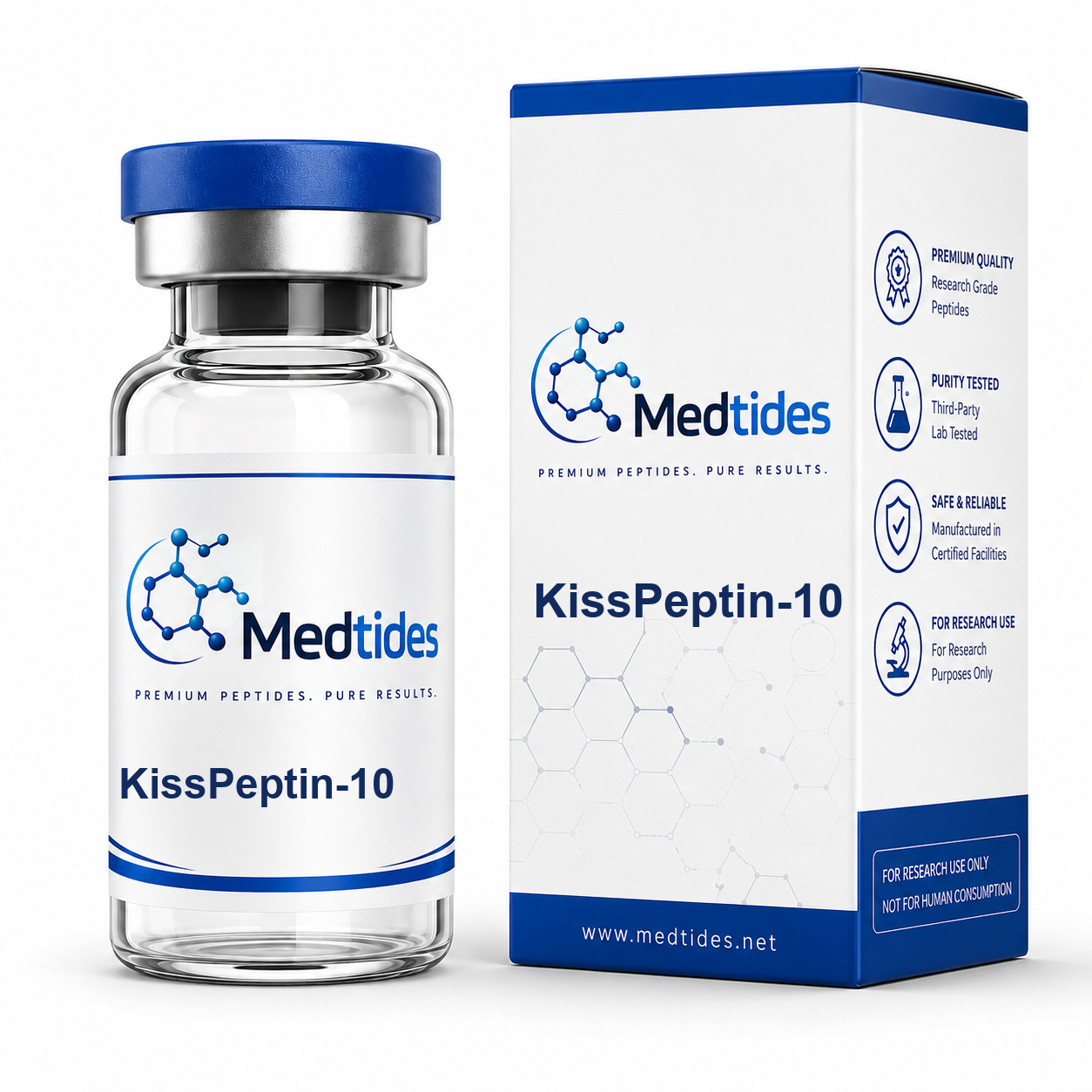
KissPeptin-10
$52.00
Kisspeptin-10: A Detailed Description, Biological Role, Research Applications, and Clinical Potential
Kisspeptin-10 (Kp-10) is a short, naturally occurring neuropeptide fragment that plays an important role in regulating the body’s reproductive endocrine system. It belongs to the kisspeptin family of signaling peptides and is best known for its ability to stimulate the kisspeptin receptor (KISS1R), which in turn activates neurons responsible for releasing gonadotropin-releasing hormone (GnRH). Through this pathway, kisspeptin can influence the secretion of luteinizing hormone (LH), follicle-stimulating hormone (FSH), and ultimately the sex hormones produced by the gonads. (PubMed)
Kisspeptin-10 is particularly interesting because it represents the smallest naturally occurring kisspeptin fragment with substantial biological activity. It is derived from the larger precursor encoded by the KISS1 gene and shares its biologically important C-terminal sequence with longer kisspeptins such as kisspeptin-54. Research into Kp-10 has helped scientists understand how the brain communicates with the reproductive organs and has opened potential avenues for investigating infertility, reproductive hormone disorders, puberty, and assisted reproduction. (PubMed)
It is important to emphasize that kisspeptin-10 is primarily a research and investigational peptide rather than a routine consumer medicine. Although human studies have demonstrated powerful effects on reproductive hormone secretion, its clinical applications, optimal formulations, long-term safety, and appropriate therapeutic use remain subjects of ongoing research.
What Is Kisspeptin?
To understand Kp-10, it is helpful to begin with the broader kisspeptin system.
Kisspeptins are peptides produced from a precursor protein encoded by the KISS1 gene. The precursor is processed into several biologically active forms, including kisspeptin-54, kisspeptin-14, kisspeptin-13, and kisspeptin-10. These molecules share a common C-terminal decapeptide sequence. Kisspeptin-10 is the smallest of the naturally occurring forms and retains the structural features required to activate KISS1R. (PubMed)
The kisspeptin-10 system was initially investigated in the context of cancer biology because KISS1 was identified as a gene associated with suppression of metastatic spread. Researchers later made a much more significant discovery for reproductive biology: mutations affecting the kisspeptin receptor were associated with abnormal puberty and hypogonadotropic hypogonadism, demonstrating that kisspeptin signaling is essential for normal reproductive development. (PubMed)
This discovery transformed kisspeptin from an interesting cancer-related peptide into one of the most important signaling systems studied in reproductive endocrinology.
Structure of Kisspeptin-10
Kisspeptin-10 is a 10-amino-acid peptide, making it considerably smaller than kisspeptin-54. Despite its short length, it contains the critical sequence required for interaction with KISS1R.
The peptide’s C-terminal end is particularly important for biological activity. Like other kisspeptins, Kp-10 possesses a C-terminal RF-amide structure, which contributes to its receptor-binding characteristics. Research has demonstrated that Kp-10 can activate KISS1R and trigger intracellular signaling even though it is much shorter than the full-length kisspeptin-54 molecule. (PubMed)
The small size of Kisspen-10 makes it attractive for laboratory research and peptide chemistry. However, its small size also contributes to an important limitation: rapid enzymatic degradation and clearance can reduce its duration of action. Experimental research has found that Kisspen-10 can degrade rapidly under certain laboratory conditions, illustrating why peptide stability is an important consideration in research and therapeutic development. (PubMed)
Scientists have therefore investigated modified kisspeptin analogues designed to maintain receptor activity while improving resistance to degradation and extending biological effects. (PubMed)
The Kisspeptin-KISS1R Pathway
The central biological role of Kisspeptin-10 can be visualized as a chain of communication:
Kisspeptin → KISS1R → GnRH → LH/FSH → Gonadal hormones and reproductive function
Kisspeptin binds to KISS1R, a G-protein-coupled receptor expressed on or associated with GnRH neurons. Activation of this receptor triggers intracellular signaling pathways, including Gαq/11-associated signaling and phospholipase C activity, which ultimately influences neuronal excitation and GnRH secretion. (PubMed)
GnRH is released from the hypothalamus in pulses and travels to the pituitary gland. There, it stimulates the secretion of LH and FSH.
LH and FSH then act on the reproductive organs. In males, these hormones influence testosterone production and sperm production. In females, they regulate follicular development, estrogen production, ovulation, and aspects of the menstrual cycle.
Because kisspeptin sits relatively high in this biological hierarchy, it has sometimes been described as a gatekeeper or upstream regulator of the reproductive axis. (PubMed)
Kisspeptin-10 and Puberty
One of the most important discoveries surrounding kisspeptin was its relationship with puberty.
Before puberty, the hypothalamic-pituitary-gonadal axis is relatively suppressed. At puberty, this system becomes progressively activated. Kisspeptin-10 producing neurons are believed to be an important part of the signaling network that helps initiate this transition.
Genetic evidence strongly supports this role. Loss-of-function mutations affecting KISS1R can result in failure of normal pubertal development and hypogonadotropic hypogonadism, while mutations that increase KISS1/KISS1R signaling have been associated with premature puberty. (PubMed)
This makes the kisspeptin pathway particularly important for understanding disorders involving either delayed or abnormally early reproductive maturation.
Kp-10 itself is not simply a “puberty hormone.” Rather, it is one component of a sophisticated neuroendocrine system that integrates reproductive, metabolic, environmental, and hormonal signals.
Effects on LH and FSH
One of the clearest findings from human research is that exogenous kisspeptin-10 can stimulate LH secretion.
In an experimental study involving healthy men, intravenous Kisspeptin-10 produced a rapid, dose-dependent increase in serum LH. Continuous infusion also increased LH pulse frequency and was associated with an increase in testosterone concentrations. (PubMed)
These findings are significant because they demonstrate that the kisspeptin pathway is not merely theoretical in humans. Administration of the peptide can influence the reproductive endocrine system in measurable ways.
However, the response is not necessarily linear. Higher exposure does not automatically mean proportionally greater biological effects. In the cited human study, the largest tested bolus did not produce a stronger LH response than an intermediate dose, illustrating the complexity of neuroendocrine signaling. (PubMed)
This is one reason why experimental results should not be converted directly into self-administration schedules.
Effects in Men
In males, kisspeptin signaling influences the hypothalamic-pituitary-gonadal axis and therefore can affect LH and testosterone.
Human research has demonstrated that Kisspeptin-10 administration can stimulate LH secretion and increase testosterone under experimental conditions. (PubMed)
The biological sequence can be summarized as:
Kp-10 → KISS1R activation → GnRH signaling → LH secretion → stimulation of Leydig-cell testosterone production
FSH is also part of the reproductive axis, particularly in relation to Sertoli-cell function and spermatogenesis.
This has generated interest in kisspeptin as a possible tool for investigating disorders involving insufficient hypothalamic GnRH signaling. Rather than directly replacing testosterone, kisspeptin acts further upstream and attempts to stimulate the body’s own reproductive signaling pathway.
That distinction is scientifically important because the goal of a kisspeptin-based approach may be to reactivate endogenous reproductive signaling rather than simply provide a downstream hormone.
Effects in Women
Kisspeptin is equally important in female reproductive physiology.
In women, kisspeptin signaling contributes to the regulation of GnRH, LH, FSH, ovarian activity, and the menstrual cycle. Experimental studies have examined its potential role in conditions such as hypothalamic amenorrhea and other reproductive endocrine disorders. (PubMed)
One exploratory study investigated Kisspeptin-10 in women with hyperprolactinemia-associated chronic amenorrhea. Kp-10 administration increased LH and FSH and was accompanied by increases in estradiol, testosterone, and inhibin B, suggesting activation of the reproductive axis. (PubMed)
These findings are scientifically interesting because they demonstrate that the kisspeptin system can potentially serve as a bridge between hypothalamic signaling and ovarian function.
Nevertheless, these studies are not equivalent to establishing Kp-10 as a universally approved fertility treatment.
Kisspeptin and Ovulation
Another major research area is ovulation.
Ovulation requires a substantial preovulatory LH surge. Kisspeptin-10 neurons are involved in the physiological mechanisms that generate this surge. Consequently, researchers have investigated whether exogenous kisspeptin could be used to stimulate an LH surge in controlled reproductive settings.
Both Kisspeptin-10 and longer kisspeptins have demonstrated the ability to stimulate reproductive hormone secretion, and kisspeptin-based approaches have been investigated as potential triggers for oocyte maturation in assisted reproduction. (PubMed)
Most clinical development in this area has focused more heavily on kisspeptin-54 and longer-acting kisspeptin approaches than on Kp-10 itself, partly because the shorter peptide is more vulnerable to degradation and may have a shorter duration of action.
This distinction is important when discussing “kisspeptin” generally. Results obtained with kisspeptin-54 should not automatically be interpreted as evidence for identical performance of kisspeptin-10.
Kisspeptin and Fertility Research
The reproductive system must constantly integrate signals concerning energy availability, stress, body composition, and overall physiological condition.
Kisspeptin is believed to be one of the signaling systems through which the brain connects metabolic status with reproductive function. (PubMed)
This relationship helps explain why severe undernutrition, excessive energy expenditure, significant metabolic disturbances, and other physiological stresses can affect reproductive function.
Researchers are investigating whether manipulating kisspeptin signaling could help restore reproductive hormone activity in selected forms of reproductive dysfunction. Potential areas of investigation include hypogonadotropic hypogonadism, hypothalamic amenorrhea, and certain infertility settings.
A systematic review of clinical trials identified numerous investigations involving kisspeptin in reproductive medicine, including studies involving puberty, ovarian function, infertility, amenorrhea, and assisted reproduction. However, the clinical evidence remains heterogeneous and additional research is required before many proposed applications can become routine treatments. (PubMed)
Kisspeptin and Assisted Reproduction
The possibility of using kisspeptin to trigger oocyte maturation is particularly interesting.
Traditional assisted-reproduction protocols can use agents such as human chorionic gonadotropin or GnRH agonists to induce final oocyte maturation. Kisspeptin-10 offers a different conceptual approach because it acts upstream, stimulating the body’s own GnRH and gonadotropin pathways.
Researchers have investigated kisspeptin-based triggers in women undergoing IVF, with particular interest in patients who may be at increased risk of ovarian hyperstimulation syndrome (OHSS). Reviews have described encouraging results with kisspeptin, especially kisspeptin-54, but also emphasize the need for further research concerning optimal protocols and reproductive outcomes. (PubMed)
Thus, kisspeptin-10 should be viewed as an investigational tool within reproductive medicine rather than as a general-purpose fertility supplement.
Placental and Pregnancy Research
The kisspeptin-10 system also has a fascinating role in pregnancy and placental biology.
The placenta produces substantial amounts of kisspeptin-10, and circulating kisspeptin concentrations change dramatically during pregnancy. Researchers have investigated relationships between kisspeptin signaling and trophoblast invasion, placental development, and pregnancy-related disorders. (PubMed)
Trophoblast invasion is a highly controlled process in which placental cells interact with and penetrate the maternal uterine environment. Too little or excessive invasion can be associated with pregnancy complications.
Recent research continues to investigate the relationship between the KISS1/KISS1R system and conditions such as fetal growth restriction and pre-eclampsia. However, these relationships are still being studied, and differences in assay methods and patient populations make it difficult to draw definitive clinical conclusions. (PubMed)
Kisspeptin and Metabolism
Kisspeptin-10 is also being investigated as a potential link between energy metabolism and reproductive function.
Reproduction is energetically expensive, so the body needs mechanisms that can determine whether sufficient metabolic resources are available to support reproductive activity. Kisspeptin neurons interact with broader neuroendocrine networks that respond to nutritional and metabolic signals.
This does not mean Kp-10 is a conventional weight-loss peptide. It should not be categorized alongside metabolic therapies primarily intended to reduce appetite or body weight.
Instead, its metabolic significance lies in the way it may help the reproductive system respond to the body’s overall physiological state.
Kisspeptin and Cancer Research
The history of kisspeptin began partly in cancer research.
The KISS1 gene was initially associated with suppression of metastatic behavior, and the peptide system was originally investigated for its potential role in regulating cancer-cell migration and invasion. Later research established its major role in reproductive endocrinology. (PubMed)
Kisspeptin signaling remains an area of cancer research because KISS1/KISS1R activity may influence cell migration and metastatic processes in certain experimental models.
However, the relationship is complex. It would be inappropriate to describe Kp-10 as an established cancer treatment or as a general anti-cancer agent. Findings from cell and animal studies require extensive validation before they can be translated into clinical treatment.
Pharmacokinetics and Stability
One of the limitations of Kp-10 is its short biological lifetime.
Peptides can be vulnerable to enzymatic degradation, and experimental work has demonstrated that Kp-10 can break down relatively rapidly under laboratory conditions. A pharmacokinetic study in rats found rapid disappearance after intravenous administration, while stability experiments demonstrated degradation over short time periods at different temperatures. (PubMed)
This rapid degradation has several implications.
First, it means that Kp-10 may require carefully controlled experimental delivery when researchers want to maintain a particular biological exposure.
Second, it explains why longer kisspeptins or modified analogues may sometimes be preferred for therapeutic development.
Third, it highlights why a synthetic peptide purchased from an unverified source should not be assumed to have the same stability, purity, or biological activity as a properly characterized research material.
Kisspeptin-10 Versus Kisspeptin-54
Kp-10 and Kp-54 are closely related but should not be treated as identical products.
Kisspeptin-54 is a 54-amino-acid peptide, while kisspeptin-10 contains only the biologically active decapeptide sequence. Both can activate KISS1R, but their pharmacokinetic behavior differs. Kp-10 is particularly susceptible to degradation and clearance, whereas longer kisspeptin forms have sometimes been more useful for sustained biological stimulation. (PubMed)
This distinction matters when interpreting scientific literature. A study involving Kp-54 does not automatically establish the efficacy or safety of Kp-10.
Likewise, the term “kisspeptin” can refer to the entire peptide family rather than one specific molecular form.
Research Applications
Kp-10 is valuable as a research tool because it provides a relatively direct method for activating KISS1R signaling.
Researchers can use it to investigate:
- GnRH neuron biology
- LH and FSH secretion
- Pubertal development
- Hypothalamic-pituitary-gonadal axis function
- Male reproductive endocrinology
- Female reproductive endocrinology
- Ovulatory mechanisms
- Hypothalamic amenorrhea
- Metabolic-reproductive interactions
- Placental biology
- Trophoblast signaling
- KISS1R pharmacology
- Development of longer-acting kisspeptin analogues
Because the peptide produces measurable endocrine responses, it can be particularly useful in controlled experimental settings designed to understand whether the reproductive axis is responsive to upstream stimulation.
Safety and Limitations
The fact that Kp-10 occurs naturally in the body does not mean that administering synthetic Kp-10 is automatically safe.
Exogenous administration can produce acute changes in reproductive hormones, including LH, FSH, testosterone, and estradiol. The physiological consequences of repeatedly manipulating these pathways over long periods are not completely established.
Human studies have generally involved carefully selected participants, controlled experimental conditions, and specific administration protocols. These circumstances are very different from unsupervised use of research peptides.
Another important concern is product quality. Products sold online under names such as “Kisspeptin-10” may be labeled as research chemicals rather than approved medicines. Their identity, purity, sterility, concentration, stability, and absence of contaminants may not be independently verified.
Consequently, research-grade Kp-10 should not be represented as a proven therapeutic product simply because published studies demonstrate biological activity.
Storage and Handling
Kp-10 is a peptide and should be handled according to the specific manufacturer’s validated storage instructions.
This is particularly important because research has demonstrated that Kp-10 can degrade relatively quickly under some conditions. (PubMed)
Storage requirements can differ according to whether the material is supplied as a dry, lyophilized peptide or as a prepared solution. Temperature, moisture, pH, solvent, light exposure, and repeated freeze-thaw cycles can all affect peptide stability.
Therefore, there is no responsible universal storage instruction that can be applied to every Kp-10 product. Researchers should consult the product’s certificate of analysis, technical documentation, and manufacturer’s stability information.
A peptide that has been improperly stored should not be assumed to retain its original potency or purity.
Current Clinical Status
The scientific literature provides strong evidence that kisspeptin signaling is fundamental to human reproductive physiology. Human studies have demonstrated that exogenous kisspeptin can stimulate gonadotropin secretion, and experimental work has explored its use in reproductive disorders and assisted reproduction. (PubMed)
However, there is an important distinction between demonstrating biological activity and establishing an approved treatment.
Kisspeptin-based therapies remain an active area of research. Some approaches, particularly longer-acting kisspeptin formulations or analogues, have progressed further in reproductive research than native Kp-10. Additional clinical trials are needed to establish optimal administration strategies, patient selection, long-term safety, and comparative effectiveness.
Kp-10 should therefore be regarded primarily as an investigational peptide and research tool, unless a specific formulation has been approved for a particular indication by the relevant regulatory authority.
Overall Significance
Kisspeptin-10 is a remarkable example of how a very small peptide can exert profound effects on a complex physiological system.
Its importance comes not from acting directly on the reproductive organs, but from its position relatively high in the neuroendocrine control system. By activating KISS1R, Kp-10 can influence GnRH neurons, which then influence pituitary gonadotropins and, ultimately, gonadal function.
The pathway can be summarized as:
Kisspeptin-10 → KISS1R → GnRH → LH/FSH → Gonadal function
This signaling cascade helps explain why kisspeptin has become such an important subject in reproductive endocrinology.
The peptide’s potential applications are broad. Researchers are studying it in relation to infertility, hypothalamic amenorrhea, hypogonadotropic hypogonadism, puberty, ovulation, IVF, placental development, and the relationship between metabolism and reproductive function. (PubMed)
At the same time, its limitations are equally important. Kp-10 is relatively short-lived, can undergo rapid degradation, and produces powerful endocrine effects. Long-term or unsupervised administration therefore cannot be assumed to be safe merely because the molecule is naturally produced by the body.
Conclusion
Kisspeptin-10 is a biologically active decapeptide derived from the KISS1 gene and one of the key molecular regulators of the reproductive endocrine system. Its ability to activate KISS1R and stimulate GnRH secretion makes it an important upstream regulator of LH, FSH, testosterone, estrogen, ovarian activity, and reproductive development.
Its discovery fundamentally changed understanding of puberty and reproductive physiology. Genetic studies demonstrated that disruption of kisspeptin signaling can interfere with normal reproductive maturation, while experimental administration of kisspeptin can stimulate reproductive hormone secretion in humans. (PubMed)
Kp-10 has also become an important laboratory tool for investigating reproductive endocrinology. Its potential applications in fertility treatment, ovulation induction, hypothalamic amenorrhea, and other reproductive disorders are scientifically promising, but many remain investigational. Research involving longer kisspeptin forms and modified analogues is particularly important because native Kp-10 is susceptible to rapid degradation. (PubMed)
Ultimately, Kp-10 should be understood not as a general wellness or performance-enhancing peptide, but as a powerful research molecule within the kisspeptin-KISS1R-GnRH reproductive signaling system. Its greatest significance lies in what it has taught scientists about the communication between the brain, pituitary gland, gonads, metabolism, and reproductive system—and in the possibility that this pathway may eventually lead to more physiological approaches to treating selected reproductive disorders.
Be the first to review “KissPeptin-10”
Related products

PEPTIDES PRODUCTS

PEPTIDES PRODUCTS

PEPTIDES PRODUCTS
PEPTIDES PRODUCTS

PEPTIDES PRODUCTS
PEPTIDES PRODUCTS

PEPTIDES PRODUCTS

PEPTIDES PRODUCTS
Reviews
There are no reviews yet.