
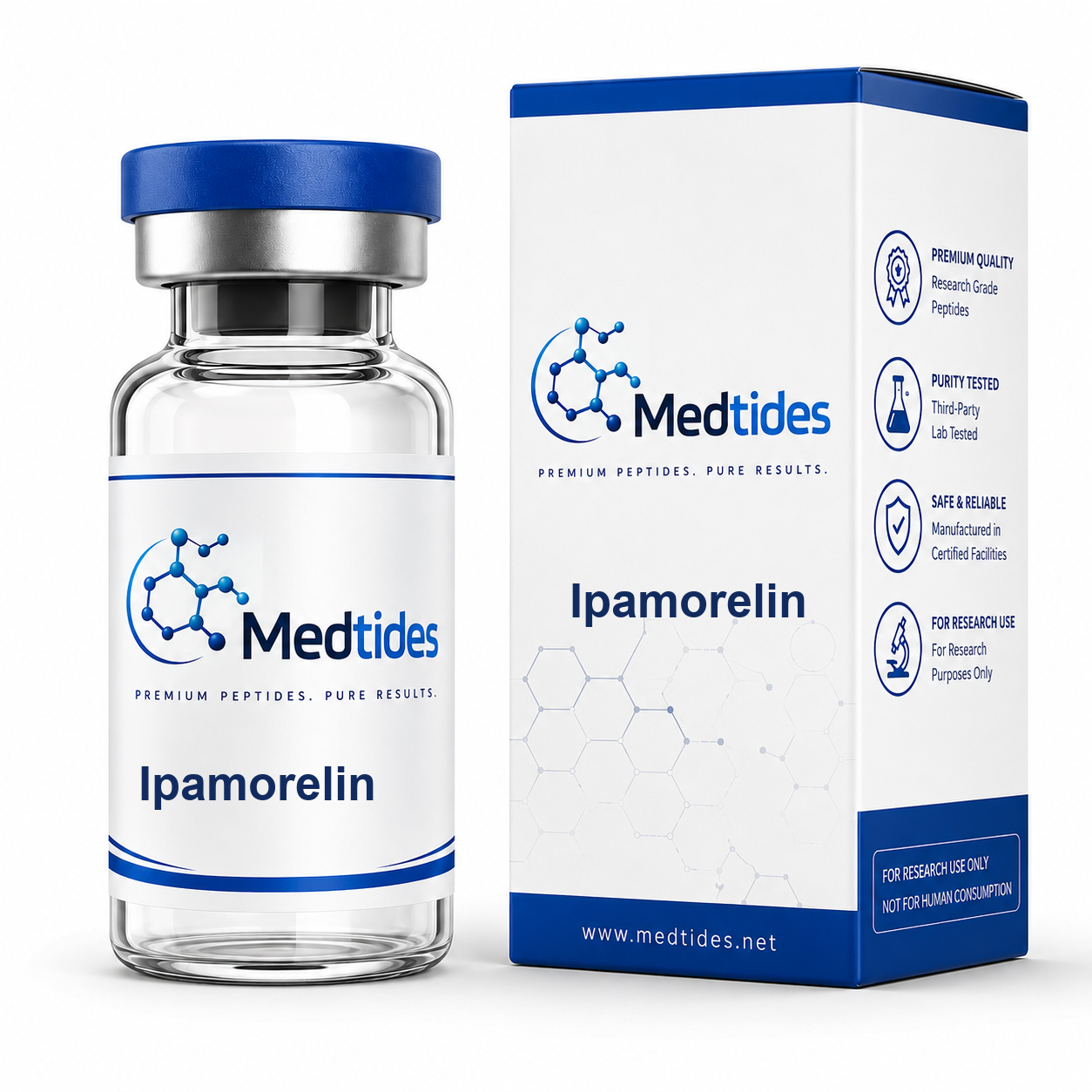
Ipamorelin 1
Original price was: $100.00.$90.00Current price is: $90.00.
Ipamorelin: Overview, Usage, Biological Effects, and Storage Methods
Introduction
Ipamorelin is a synthetic peptide belonging to a class of compounds known as growth hormone secretagogues (GHSs). It was developed as a selective stimulator of growth hormone (GH) release and is structurally related to the earlier growth hormone-releasing peptides (GHRPs). Unlike growth hormone itself, ipamorelin does not directly supply the body with recombinant GH. Instead, it is designed to stimulate the body’s own pituitary gland to release GH through activation of the growth hormone secretagogue receptor (GHS-R). (PuMed)
Ipamorelin is a particularly interesting peptide because early pharmacological research suggested that it could stimulate GH release while producing considerably less stimulation of certain other pituitary hormones than some older GHRP compounds. In the original characterization studies, ipamorelin demonstrated strong GH-releasing activity without significant effects on prolactin, luteinizing hormone, or follicle-stimulating hormone, and it produced substantially less ACTH and cortisol stimulation than several comparator secretagogues. (PubMed)
Despite this promising pharmacology, ipamorelin should not be confused with an established treatment for bodybuilding, anti-aging, muscle growth, or general wellness. In particular, the U.S. Food and Drug Administration (FDA) has stated that it has not identified sufficient evidence supporting ipamorelin for the diagnosis or treatment of growth hormone deficiency in adults or children. FDA has also highlighted safety and quality concerns associated with compounded ipamorelin acetate, including potential immunogenicity and peptide-related impurities. (U.S. Food and Drug Administration)
What Is Ipamorelin?
Ipamorelin is a pentapeptide, meaning that its active peptide structure contains five principal amino-acid residues. Its reported chemical sequence is Aib-His-D-2-Nal-D-Phe-Lys-NH₂, incorporating non-proteinogenic amino acids such as amino-isobutyric acid and naphthylalanine. These unusual structural components contribute to its receptor activity and also make characterization of the compound more complex than that of ordinary biological peptides. (PubMed)
The compound was developed through research into growth hormone-releasing peptides. Scientists were looking for molecules capable of producing a strong GH response while minimizing undesirable hormonal effects associated with earlier secretagogues.
The resulting compound, ipamorelin, demonstrated a relatively selective profile in preclinical experiments. In the original study, it stimulated GH release with potency and efficacy comparable to GHRP-6 while showing little or no significant stimulation of ACTH and cortisol at doses substantially above those required for GH release. (PubMed)
This selectivity is one of the principal reasons ipamorelin became an important research compound in endocrinology.
How Ipamorelin Works
The body’s natural GH system is highly regulated. Growth hormone is produced by specialized cells in the anterior pituitary gland and is released in pulses rather than at a constant rate.
Several signaling systems participate in this regulation. Growth hormone-releasing hormone (GHRH) stimulates GH secretion, while somatostatin suppresses it. Ghrelin and related signaling pathways can also stimulate GH release through the growth hormone secretagogue receptor. (PubMed)
Ipamorelin acts primarily as an agonist of the GHS receptor, sometimes called the ghrelin receptor. Activation of this receptor contributes to signaling that promotes GH secretion from pituitary somatotroph cells.
The resulting pathway can be simplified as:
Ipamorelin → GHS-R activation → pituitary GH release → GH signaling → IGF-1 and downstream physiological effects
This is fundamentally different from administering recombinant human growth hormone. Ipamorelin attempts to stimulate endogenous GH secretion, whereas recombinant GH directly provides the hormone.
This distinction is clinically important because an intact and responsive GH-producing system is necessary for a secretagogue to have its intended effect. FDA materials specifically note that patients with complete GH deficiency may not respond adequately to growth hormone secretagogues because these compounds depend on remaining pituitary function. (U.S. Food and Drug Administration)
Growth Hormone and IGF-1
To understand the potential biological effects of ipamorelin, it is useful to understand the GH–IGF-1 axis.
Growth hormone enters the bloodstream after being released from the pituitary. It acts directly on numerous tissues and also stimulates production of insulin-like growth factor-1 (IGF-1), particularly in the liver. IGF-1 then contributes to many of the longer-term effects associated with GH signaling.
The GH–IGF-1 system participates in:
- Growth and development
- Protein metabolism
- Bone metabolism
- Connective-tissue processes
- Substrate utilization
- Regulation of body composition
- Cellular growth and repair
Because ipamorelin can increase endogenous GH secretion, researchers have investigated whether it can consequently influence downstream markers such as IGF-1.
However, the presence of an increase in GH or IGF-1 does not automatically demonstrate that a person will experience a desired change in muscle mass, fat mass, athletic performance, or physical appearance. Those outcomes depend on numerous additional physiological factors.
Research Into Ipamorelin
The initial scientific work on ipamorelin was primarily pharmacological. Researchers evaluated its ability to stimulate GH release in laboratory systems and animal models before examining its pharmacokinetic and pharmacodynamic behavior in humans.
The original animal research demonstrated strong GH-releasing activity. In rats and pigs, ipamorelin produced substantial GH responses comparable to other well-known growth hormone secretagogues. Importantly, researchers observed considerably greater selectivity for GH release than with certain older GHRP compounds. (PubMed)
Human pharmacokinetic research subsequently investigated how ipamorelin behaves in the body. A study involving healthy male volunteers found a short terminal half-life of approximately two hours following intravenous administration, with GH stimulation reaching a peak at roughly 0.67 hours in the experimental setting. (PubMed)
These results illustrate an important characteristic of ipamorelin: although its biological effects involve the GH axis, the peptide itself does not remain in circulation indefinitely. Its pharmacological effects and its physical presence in the bloodstream are related but not identical.
Potential Uses and Areas of Investigation
Ipamorelin has been investigated primarily as a growth hormone secretagogue. Researchers have considered whether compounds in this category might have applications in conditions involving inadequate GH secretion or other disturbances of the GH axis.
Historically, the development of GH secretagogues has included investigation into:
- Growth hormone deficiency
- Growth-related disorders
- Metabolic research
- Body-composition research
- Muscle and tissue biology
- Recovery and repair mechanisms
- Endocrine disorders
However, these research areas should not be confused with approved clinical indications.
The FDA’s Pharmacy Compounding Advisory Committee materials specifically state that the agency has not identified data supporting the effectiveness of ipamorelin free base or ipamorelin acetate for diagnosing or treating GH deficiency in adults or children. (U.S. Food and Drug Administration)
Therefore, claims that ipamorelin is an established treatment for GH deficiency, muscle wasting, aging, or athletic performance are not supported by the current regulatory evidence.
Ipamorelin and Bodybuilding
Ipamorelin has become particularly well known outside conventional medicine because it is frequently discussed in bodybuilding and physique-enhancement communities.
The rationale behind this interest is understandable. Since GH is involved in protein metabolism, connective-tissue biology, and fat metabolism, some users have hypothesized that stimulating endogenous GH might contribute to improved body composition or recovery.
However, the scientific evidence does not establish ipamorelin as a proven bodybuilding or performance-enhancing treatment.
In particular, increased GH secretion does not necessarily translate into proportional increases in muscle strength or lean muscle mass. Human physiology is considerably more complicated than simply increasing one hormone.
Recent reviews of performance-enhancing peptides have emphasized the gap between online self-administration practices and the quality of clinical evidence available for many GH-axis peptides, including ipamorelin. Such reviews identify uncertainties surrounding effectiveness, product quality, dosing practices, endocrine effects, and long-term safety. (PubMEd)
For this reason, ipamorelin should be described accurately as an investigational growth hormone secretagogue, rather than as a proven muscle-building product.
Ipamorelin and Fat Metabolism
Growth hormone has important effects on lipid metabolism, which has contributed to interest in GH secretagogues as potential body-composition agents.
However, research does not support the simplistic idea that ipamorelin directly “burns fat.” The biological relationship between GH secretion and adipose tissue is complex.
Interestingly, experimental animal research has even produced findings that caution against assuming that every GH secretagogue will automatically reduce body fat. One study found that ipamorelin increased relative fat-pad weight in certain mice, illustrating that the metabolic consequences of secretagogue treatment can be more complicated than expected. (PubMed)
Consequently, ipamorelin should not be marketed as a guaranteed fat-loss compound.
Possible Effects on Recovery and Tissue Biology
GH and IGF-1 participate in biological processes involving connective tissue, bone, protein metabolism, and cellular repair. This has led to considerable interest in whether GH secretagogues might influence recovery from physical stress or injury.
Nevertheless, there is insufficient clinical evidence to establish ipamorelin as a general-purpose recovery treatment.
The distinction between biological plausibility and demonstrated clinical benefit is important. A molecule can influence a pathway associated with tissue repair without necessarily producing a clinically meaningful improvement when administered to patients.
This is particularly relevant to peptide marketing, where mechanistic descriptions can sometimes be presented as if they were established clinical outcomes.
Administration and Usage
Ipamorelin has been investigated through different experimental routes, including parenteral administration. Historical pharmacokinetic research also examined nasal delivery in animal models. In one study, intranasal administration in rats produced estimated systemic bioavailability of approximately 20%. (PubMed)
However, these experimental findings should not be interpreted as a universal recommendation for how people should administer ipamorelin.
Products sold online may be supplied as lyophilized powder intended for laboratory research, while compounded formulations may be supplied in other presentations. The concentration, purity, formulation, route, and stability can vary considerably.
For this reason, there is no single appropriate “ipamorelin dose” that can safely be recommended for general self-administration. Dosing protocols encountered on peptide websites or bodybuilding forums should not be treated as medical instructions.
A healthcare professional or appropriately qualified research supervisor should determine whether a particular formulation is suitable for its intended purpose and how it should be handled.
Why Dose Escalation and Self-Administration Are Concerns
The GH system is an endocrine system rather than an isolated biological pathway. Manipulating it can influence multiple downstream processes.
Increasing GH signaling can affect IGF-1 and other metabolic pathways. Potential concerns associated with excessive or inappropriate GH-axis stimulation include:
- Changes in glucose metabolism
- Fluid retention
- Joint or muscle discomfort
- Headache
- Alterations in insulin sensitivity
- Changes in endocrine signaling
- Possible effects associated with excessive IGF-1 exposure
These potential effects do not mean that every person receiving an experimental dose will experience them. Rather, they demonstrate why endocrine-active peptides should not be treated like ordinary nutritional supplements.
Long-term safety is another major uncertainty. Many online ipamorelin protocols involve repeated use over periods for which robust long-term clinical safety data are lacking.
Regulatory and Safety Status
Regulatory status is one of the most important considerations when discussing ipamorelin.
The FDA has identified ipamorelin acetate as a substance associated with concerns in the context of compounded drugs. According to FDA materials, compounded drugs containing ipamorelin acetate may pose risks related to immunogenicity, aggregation, and peptide-related impurities. The agency also notes that the characterization of the peptide is complicated by its incorporation of unnatural amino acids. (U.S. Food and Drug Administration)
FDA materials additionally reference a study in which serious adverse events, including death, occurred when ipamorelin was administered intravenously for investigation of gastric motility. The FDA states that it lacks sufficient information to determine whether ipamorelin acetate would cause harm through certain other injectable routes. (U.S. Food and Drug Administration)
This information is particularly important because it demonstrates that route of administration matters. A safety profile observed under one experimental route cannot simply be assumed to apply to every other route.
Quality and Purity
Peptide quality is a major concern when purchasing ipamorelin outside a regulated pharmaceutical supply chain.
A laboratory or clinical-grade peptide requires appropriate characterization to confirm:
- Identity
- Purity
- Concentration
- Structural integrity
- Absence of significant impurities
- Appropriate sterility where applicable
- Stability under specified storage conditions
Unregulated online products may not meet these standards.
The label “99% pure” alone should not be treated as proof of pharmaceutical quality. Proper analytical documentation is necessary to establish what a product actually contains.
This is particularly important for injectable preparations because contamination can create risks that do not exist with ordinary oral supplements.
Storage of Ipamorelin
Storage requirements depend on the exact formulation and manufacturer. There is no single storage temperature that can safely be applied to every ipamorelin product.
FDA materials discussing ipamorelin free base describe it as a white lyophilized powder and report a manufacturer’s recommendation for storing the material desiccated below −18°C. The same material states that, after reconstitution, the particular formulation was reported by the manufacturer to remain stable for 2–3 weeks at 4°C or 3–4 months at −20°C. (U.S. Food and Drug Administration)
These figures should not be interpreted as universal instructions for every ipamorelin preparation. They are formulation-specific stability information presented in FDA’s discussion of a particular material.
Different salts, concentrations, buffers, containers, and manufacturing processes can alter peptide stability.
Therefore, the most reliable storage procedure is always to follow the specific product’s certificate of analysis, manufacturer’s instructions, pharmacy label, and validated stability information.
Lyophilized Ipamorelin
Lyophilized, or freeze-dried, peptide is generally more stable than peptide already dissolved in solution. The absence of water reduces many degradation processes.
Research-grade lyophilized ipamorelin should therefore be maintained under the temperature and humidity conditions specified by the supplier.
The container should remain properly sealed and protected from moisture. Repeated exposure to air and humidity can compromise a peptide powder over time.
If a product has been stored outside its validated conditions, its appearance alone cannot reliably determine whether its molecular integrity has been preserved.
Reconstituted Ipamorelin
Once a lyophilized peptide is reconstituted, its stability can change substantially.
Water or another solvent introduces an environment in which degradation, aggregation, adsorption to container surfaces, and other chemical processes may occur.
For this reason, the stability period of reconstituted ipamorelin is generally shorter than that of the original dry material.
The specific solvent and concentration also matter. A stability statement for one formulation cannot automatically be transferred to another.
If a product has been reconstituted for laboratory research, researchers should follow the validated instructions accompanying that exact preparation rather than relying on generic peptide-storage charts found online.
Temperature Control
Temperature is one of the most important environmental variables affecting peptide stability.
Excessive heat can accelerate degradation, while repeated temperature cycling can potentially contribute to instability. Conversely, freezing a formulation that has not been validated for freezing may also damage the preparation.
The appropriate approach is therefore not simply “keep it cold.” Instead, it is:
Store ipamorelin at the temperature specified for the exact formulation and avoid unnecessary temperature fluctuations.
Temperature-controlled storage should ideally be monitored rather than estimated.
Light and Moisture
Light exposure can contribute to degradation of some biologically active compounds, although susceptibility varies according to molecular structure and formulation.
Keeping peptide products in their original packaging and protecting them from excessive light is therefore a sensible handling practice when consistent with the manufacturer’s instructions.
Moisture is particularly relevant to lyophilized peptides. A properly sealed container helps prevent unwanted exposure to humidity.
Repeated Freeze-Thaw Cycles
Repeated freezing and thawing can be undesirable for many protein and peptide preparations.
Each cycle can expose the molecule to changes in temperature, concentration, solubility, and physical environment. Depending on the formulation, this can contribute to aggregation or degradation.
For laboratory research, aliquoting may sometimes be used to reduce unnecessary repeated freeze-thaw exposure, but the procedure should follow validated laboratory protocols rather than improvised handling.
Appearance and Product Inspection
Researchers should inspect the container before use.
Unexpected changes such as:
- Discoloration
- Unexpected particles
- Cloudiness
- Precipitation
- Damaged packaging
- Broken seals
- Unusual odor
- Visible contamination
can indicate a problem.
However, normal appearance does not guarantee molecular integrity or sterility. A peptide can be chemically degraded without showing an obvious visual change.
Therefore, visual inspection is only one part of appropriate quality control.
Ipamorelin Versus Human Growth Hormone
Ipamorelin and recombinant human growth hormone are sometimes discussed together, but they are fundamentally different.
Human growth hormone supplies GH directly.
Ipamorelin attempts to stimulate the body’s own GH secretion.
This distinction means that ipamorelin depends on functioning components of the endogenous GH axis. FDA materials emphasize this limitation when discussing growth hormone secretagogues in the context of GH deficiency. (U.S. Food and Drug Administration)
The two approaches also have different pharmacological characteristics and should not be considered interchangeable.
Ipamorelin Versus Other Growth Hormone Secretagogues
Ipamorelin belongs to a larger family of GH secretagogues that includes compounds such as GHRP-2 and GHRP-6.
Its principal distinguishing feature is its relative selectivity for GH release.
In the original study, ipamorelin produced a GH response comparable to GHRP-6 while producing considerably less ACTH and cortisol stimulation. (PubMed)
That does not mean ipamorelin is free from endocrine effects. Rather, it means that its receptor pharmacology was comparatively selective under the experimental conditions studied.
The broader class of GH secretagogues has been investigated extensively, but clinical applications remain more limited than the popularity of these compounds in online peptide communities might suggest.
Important Limitations of Current Evidence
One of the biggest challenges surrounding ipamorelin is the difference between early pharmacological research and modern clinical evidence.
There is convincing evidence that ipamorelin can stimulate GH release. There is also human pharmacokinetic evidence describing its behavior in controlled experiments. (PubMed)
What is much less certain is whether chronic ipamorelin administration produces clinically meaningful benefits for healthy adults seeking greater muscle mass, improved recovery, reduced body fat, or anti-aging effects.
These popular claims have not been established to the same standard as approved medical treatments.
Consequently, a responsible description of ipamorelin should separate:
Established: It is a GH secretagogue capable of stimulating GH release.
Supported by early research: It has a relatively selective GH-releasing pharmacological profile.
Investigational: Its potential applications in various endocrine and metabolic conditions.
Not established: Routine use for bodybuilding, anti-aging, athletic performance, or cosmetic body recomposition.
Conclusion
Ipamorelin is a scientifically interesting pentapeptide growth hormone secretagogue that was developed to stimulate endogenous GH release with a relatively selective pharmacological profile. Its action is primarily associated with the growth hormone secretagogue receptor, leading to increased pituitary GH secretion and downstream activity within the GH–IGF-1 axis. (PubMed)
The compound’s selectivity distinguished it from earlier GHRP molecules and made it an important subject of endocrine research. Experimental studies demonstrated substantial GH-releasing activity, while human pharmacokinetic research characterized its relatively short terminal half-life and episodic GH response. (PubMed)
Ipamorelin has subsequently become popular in online bodybuilding and wellness communities because of theories surrounding muscle growth, fat metabolism, recovery, and anti-aging. However, these applications should not be confused with established medical indications. The FDA has stated that it has not identified adequate evidence supporting ipamorelin for the diagnosis or treatment of growth hormone deficiency, and it has raised specific concerns about the safety and characterization of compounded ipamorelin acetate. (U.S. Food and Drug Administration)
Storage is another important consideration. Lyophilized ipamorelin and reconstituted ipamorelin can have substantially different stability profiles. FDA materials describing one ipamorelin free-base material report manufacturer recommendations for storage below −18°C in a desiccated state and provide formulation-specific stability information after reconstitution. These values should not be generalized to every product. (U.S. Food and Drug Administration)
For that reason, the safest general principle is to follow the exact storage and handling instructions supplied with the particular formulation. Proper temperature control, protection from moisture, appropriate container handling, and avoidance of unnecessary temperature fluctuations are important for maintaining peptide integrity.
Overall, ipamorelin is best characterized as an investigational growth hormone secretagogue rather than a conventional nutritional supplement or proven performance-enhancing medicine. Its pharmacology is well established enough to make it valuable for research into GH physiology, but significant questions remain regarding long-term safety, clinical effectiveness for many proposed uses, formulation quality, and appropriate therapeutic applications. Any use involving humans should be approached through appropriate medical or regulated research channels rather than relying on unverified online products or self-directed dosing protocols.
Be the first to review “Ipamorelin 1”
Related products
PEPTIDES PRODUCTS
PEPTIDES PRODUCTS
PEPTIDES PRODUCTS
PEPTIDES PRODUCTS
PEPTIDES PRODUCTS
PEPTIDES PRODUCTS
PEPTIDES PRODUCTS
PEPTIDES PRODUCTS
Reviews
There are no reviews yet.